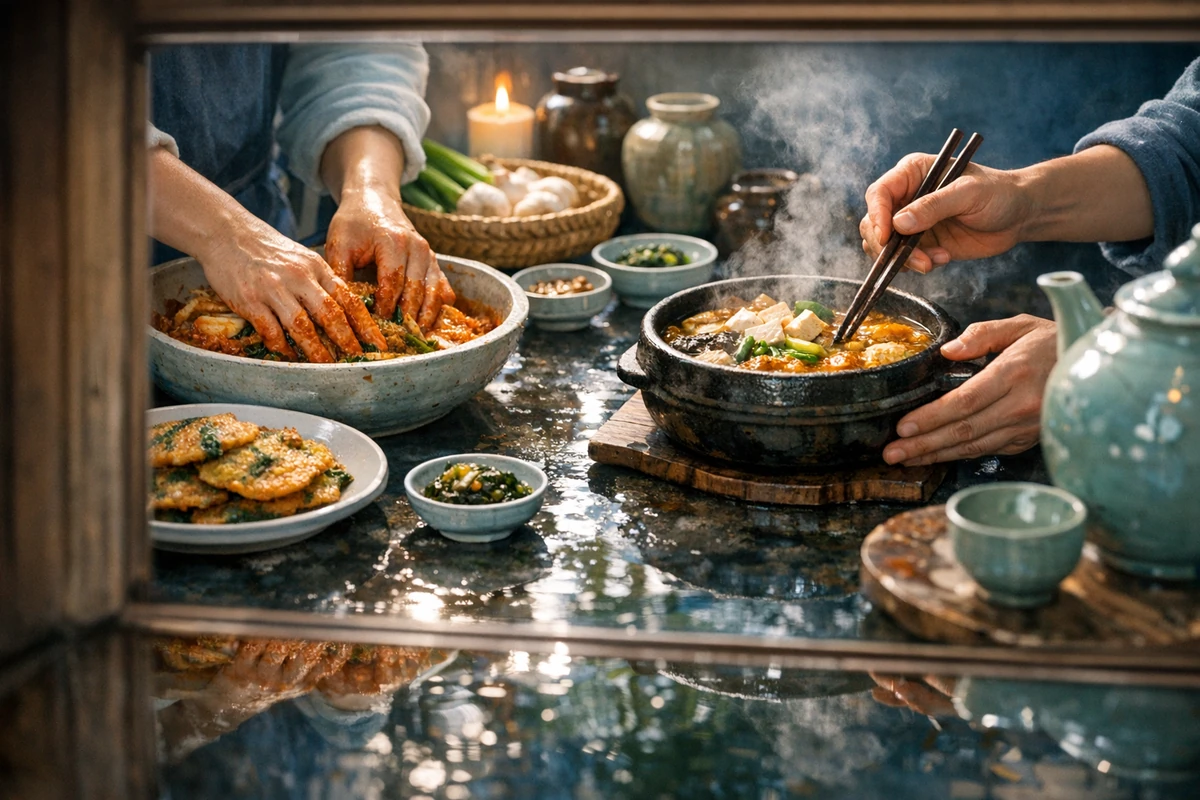
Korean Jjigae, Jeon & Kimchi: Intermediate Fermentation and Stew Craft
Build layered Korean stews, master crispy jeon technique, and control kimchi fermentation with scientific precision
About this course
Jjigae, jeon, and kimchi form the backbone of the Korean home table — yet most cooks plateau at following recipes without understanding the science that makes each dish sing. This course bridges that gap. You will learn to build 육수 (stock) that provides the umami foundation for three distinct jjigae styles, ferment two kimchi varieties while tracking pH and Lactobacillus activity, and master the batter science and heat control that separate a limp jeon from one with shattering-crispy edges. The methodology combines Chef Kim Jihoon's 20+ years of Korean culinary expertise with food-science principles. Every recipe uses gram-precise measurements, °C temperature targets, and timed steps so results are reproducible. Fermentation lessons include pH benchmarks and sensory checkpoints rather than vague instructions to 'wait until it tastes right.' Lessons follow a scaffolded progression: foundational stock and kimchi work in the first third supports jjigae construction in the middle, while jeon technique builds from simple flour batters to mung-bean-based bindaetteok in the final stretch. This course is designed for home cooks who have prepared Korean food before — you can handle a knife, you own gochugaru and doenjang, and you have cooked at least a handful of Korean dishes from recipes. You are ready to move beyond following instructions toward understanding why each step matters and how to adjust when conditions change. By course end, you will have built a complete Korean table (한상) from scratch: two fermented kimchi varieties tracked in a personal fermentation journal, three styles of jjigae, four jeon preparations, and a timed cooking schedule that brings everything to the table simultaneously at serving temperature. Every dish is documented with reproducible recipes and substitution notes in your personal portfolio.
Learning Outcomes
- ✓Analyze fermentation stages (Leuconostoc → Lactobacillus transition, pH 6.0 → 3.8) to determine kimchi readiness for eating fresh versus cooking in jjigae
- ✓Construct baechu kimchi and kkakdugi using calculated salt ratios (% by weight) and gram-precise yangnyeom for reproducible fermentation results
- ✓Evaluate anchovy-kelp stock quality by diagnosing extraction temperature effects on clarity, bitterness, and umami intensity
- ✓Apply doenjang, gochugaru, and gochujang layering sequences to build multi-dimensional flavor across three distinct jjigae styles
- ✓Execute jeon pan-frying technique with controlled surface temperature (170–180°C) and optimized batter composition to achieve consistent crispy texture
- ✓Design a timed multi-dish cooking schedule that coordinates jjigae, jeon, kimchi, and rice for simultaneous hansang (한상) table service
- ✓Synthesize fermentation science with traditional Korean seasoning ratios to adjust recipes based on kimchi age, ambient temperature, and ingredient substitutions